NEWS & KNOWLEDGE
What is Embryo Glue? Can it really help you achieve a successful pregnancy?
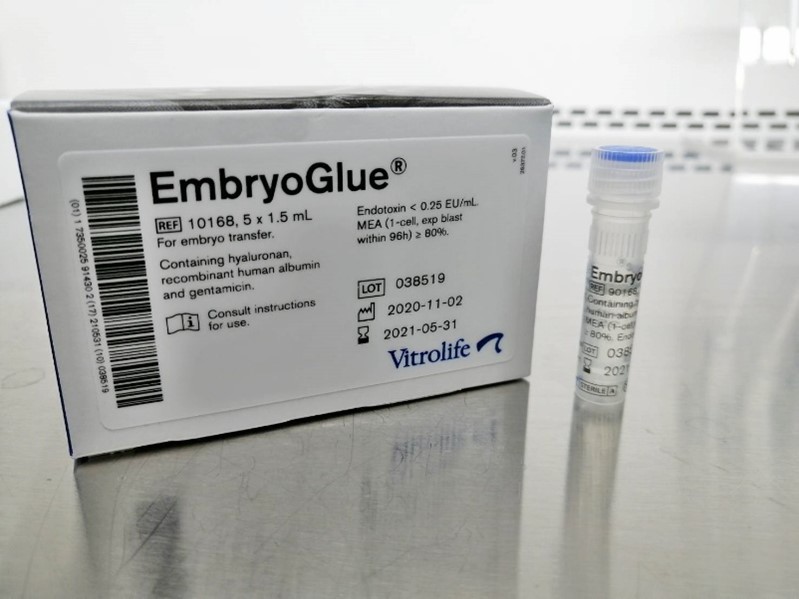
EmbryoGlue
EmbryoGlue is a solution used during embryo transfer to increase the chances of implantation.
-
Despite the name, EmbryoGlue is not actual glue; it functions like a glue, helping the embryo adhere to the uterine wall.
-
It contains concentrated hyaluronan, a natural compound normally present in the fallopian tubes and uterine fluid.
Research shows that hyaluronan levels increase in the uterus on the day of embryo implantation and decrease the next day, indicating its important role in embryo implantation.
-
By using EmbryoGlue, the uterine environment can mimic natural conditions for implantation and reduce stress on the embryo, potentially improving the likelihood of successful pregnancy.
How does EmbryoGlue work?
Hyaluronan, the key ingredient in EmbryoGlue, increases cell adhesion and helps the blastocyst attach to the endometrium.
-
Both the endometrium and the surface of the embryo have specific molecular receptors, CD44 and RHAMM/IHABP.
-
Hyaluronan binds to these receptors, acting as a self-supporting bridge between the embryo and the uterine lining.
By creating this supportive environment, EmbryoGlue mimics natural implantation, helping to increase the chances of successful embryo attachment.
Can EmbryoGlue really help you get pregnant?
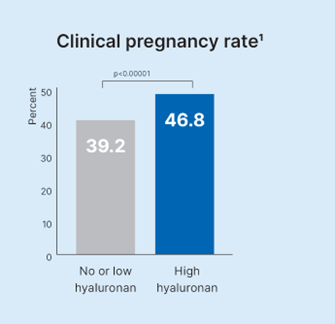
Research has shown that EmbryoGlue can increase the implantation rate of embryos, which in turn improves the pregnancy rate:
-
Using EmbryoGlue increases the pregnancy rate by 6.8% compared to standard embryo transfer fluid.
-
It also improves the live birth rate from 33.3% with normal fluid to 40.2% with EmbryoGlue.
A Cochrane review reported that EmbryoGlue can increase the chance of a live birth by 1 additional baby for every 14 embryo transfers.
For example, in a clinic performing 700 embryo transfer cycles per year, using EmbryoGlue could result in one additional baby born per week compared to using standard transfer fluid, equivalent to approximately a 20% increase in the live birth rate.
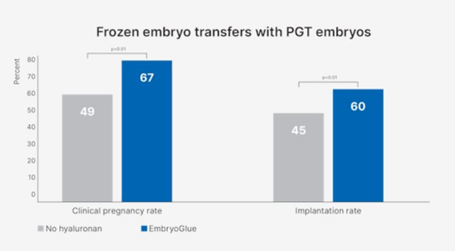
It was also found that when transferring embryos screened for chromosomal abnormalities (PGT-A), using EmbryoGlue can further improve outcomes:
-
Pregnancy rate increases by 18% compared to using standard embryo transfer fluid.
-
Embryo implantation rate improves by 15% over standard embryo culture fluid.
This suggests that EmbryoGlue may be particularly beneficial when used with chromosomally screened embryos, helping to increase both implantation and pregnancy success.
Are there any side effects from using EmbryoGlue?
According to research, using EmbryoGlue during embryo transfer has not been associated with adverse effects on the health of the child.
-
Studies have not shown an increased risk of miscarriage compared to using standard embryo transfer solutions.
Overall, EmbryoGlue is considered safe for both the embryo and the resulting child when used in assisted reproductive procedures.
Who is EmbryoGlue appropriate for?
- Spouses older than 35 years
- Couples with a history of miscarriage or embryos not implanting
- Couples who implant embryos at the blastocyst stage
- Couples who have embryos inserted in the frozen cycle
By Assoc.Prof. Matchuporn Sukprasert and Clinical Embryologist Piyarat Sopaboon
Reference documents
- Heymann D, Vidal L, Or Y, Shoham Z. Hyaluronic acid in embryo transfer media for assisted reproductive technologies. Cochrane Database Syst Rev. 2020;9(9):CD007421.
- Tyler B, Walford H, Tamblyn J, Keay SD, Mavrelos D, Yasmin E, Al Wattar BH. Interventions to optimize embryo transfer in women undergoing assisted conception: a comprehensive systematic review and meta-analyses. Hum Reprod Update. 2022;28(4):480-500.
- Reed ML, Said AH. Estimation of embryo transfer media viscosity and consideration of its effect on media and uterine fluid interactions. Reprod Biomed Online. 2019;39(6):931-939.
- Reed ML. Improved FET PGT outcomes for biopsied blastocyst transfer using Embryoglue instead of buffered transfer media: could direct, immediate contact of embryonic cells to hyaluronan be beneficial? PRS.2022. Poster.
- Adeniyi T, Horne G, Ruane PT, Brison DR, Roberts SA. Clinical efficacy of hyaluronate-containing embryo transfer medium in IVF/ICSI treatment cycles: a cohort study. Hum Reprod Open. 2021;2021(1):hoab004.
Oct 19, 2023

Oct 10, 2023
Sep 05, 2023
 ENGLISH
  THAI
THAI  中文
中文